

Let Me Read that Again
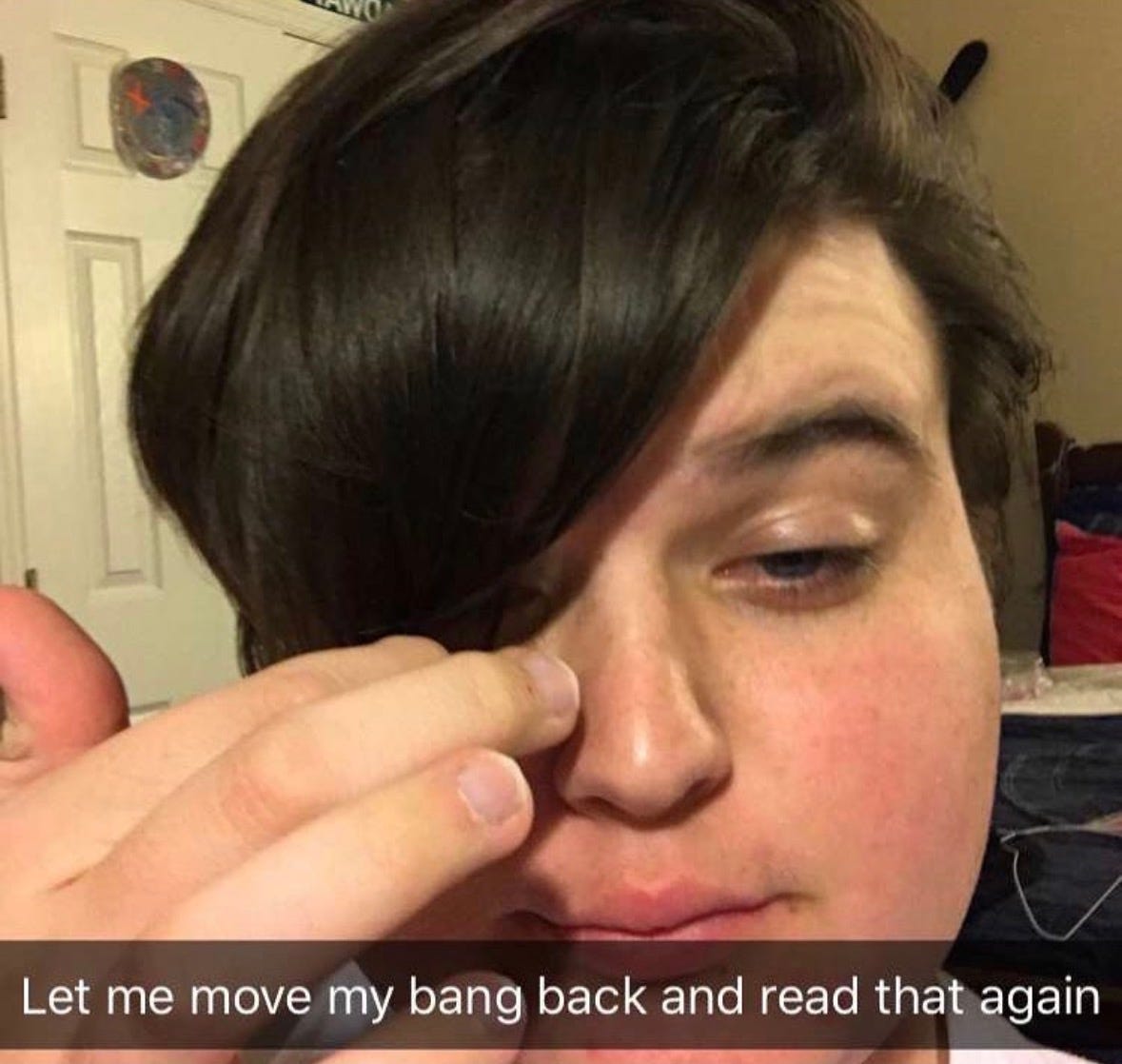
Moving my bang back and revealing my 2025 reading list

Despite the fact that, by that point, I’d lived in New York for about a year and a half, I had yet to pay a visit to The Strand. The Strand, boasting eighteen miles of books, stands as something of a relic in Union Square. Once a constituent part of the so-called “Book Row,” which was a stretch of as many as forty-eight bookstores along 4th Avenue, it now serves as one of the last remaining vestiges of that part of downtown’s history.1 One may not understand this, however, from walking through the store’s contemporary interior, complete with a café, sales displays referring to BookTok, and the iconic tote bags donning the bookstore’s logo. Speaking of contemporary, the telos of my visit that day was to acquire a copy of Sunrise on the Reaping, the latest publication from The Hunger Games universe. While I have some other book stores I like to patronize in the city, I was most confident that The Strand would have a copy of what was sure to be the year’s hottest literary commodity.
I found a copy quite quickly after I arrived. With my scavenger hunt complete, I soon found myself preoccupied with something else, which is not uncharacteristic for me when it comes to browsing in a bookstore. I was struck that day as I wandered around and took in the sheer volume of books present in the building. Eighteen miles of books was a good tagline until I saw the monstrosity of it contained within the store’s four stories; newer releases festooning the tables that cover the first floor, while tall shelves throughout each level are stacked high with new and used books alike.
While I did admire the store’s collection, it also made me melancholic. My awe at this litany of literary offerings had given way to a fatalistic realization that I would never be able to read them all. I could spend the rest of my life in monastic devotion, allowing the words of others to wash over me, and I still would have only made a dent by the time I laid on my death bed. Knowing myself, instead of abandoning my quest, I would likely neglect the loved ones gathered around me as I race through the rest of the words, deluding myself into thinking I could finish them all.
It’s a bit ridiculous, even as I write it, but I’m a bit ridiculous myself, so this was merely an instance of thought imitating its receptacle. Despite its initial foolishness, my sadness eventually evolved into a sense of relief. I couldn’t possibly read all these books, so I didn’t even have to try. Now, it’s not that I abandoned reading altogether. In fact, I was up until 5 AM recently reading my book club’s latest selection.2 Something about seeing The Strand’s collection that day inspired a change in me. Surveying the stacks, I started to release some of what I have since identified as a proclivity towards novelty. Put another way, before I beheld this bounty of books, I was placing a disproportionate emphasis on newness in my reading experience. Why, I used to think, would I use my precious time in this one beautiful life revisiting one bookish gem while leaving other literary stones unturned? After my visit, however, I started to think that perhaps there was something to, as Julian puts it in The Secret History, “know[ing] one book intimately [rather] than a hundred superficially.”
To contextualize my prejudice against rereading, between when I began reading consistently again in 2022 and the end of 2025, I have read eighty-eight books (with a couple plays in there for good measure). Out of those eighty-eight, only eleven were books I had read before. Ten of those rereads were contained within 2025 alone, meaning I had only reread one book between 2022 and the beginning of 2025. For those of you dear readers inquiring, my singular reread was of John Knowles’ A Separate Peace, which I first read in my ninth grade English class (in which I, coincidentally, reread Elie Wiesel’s Night). Back then, my teacher had invalidated my friend Matt’s questioning of whether the novel’s two main characters–Gene and Finny–are gay or, at the very least, experiencing some kind of same-sex attraction. Despite this premature snuffing of literary inquisitiveness, all those years later, I still found myself thinking about a scene in which Gene puts on Finny’s pink polo shirt and looks at himself in the mirror. Turns out, as I revisited the scene in 2022, it was just as queerly obsessive as I had left it back in 2015 when I first read it.
Before revisiting A Separate Peace, I remember rereading three books during my winter break from my first year of college. I read voraciously over that period as a way to escape the conflict that I was causing in my family, the kind of conflict that a bird returning to the nest with its stronger wings is wont to cause. My first stop, as I remember it, was appropriately The Perks of Being a Wallflower. While there was, thankfully, a great discordance between what Charlie endures in that novel and what I was going through at the time, it was still therapeutic to commiserate with Charlie’s experience of teenage angst while going through my own. In retrospect, I don’t think it’s a coincidence that I picked up this book at that moment. In other words, during this time of conflict and transition, I turned to a story I had already read to comfort myself. I felt like those people–we’ve all talked to them–who love to tell you that they simply watch their favorite tv shows over and over again instead of investing in newer ones. I’ve often found myself, with my proclivity towards the novel, judging these individuals; however, I now acknowledge that they are onto something. After all, it is natural to find relief in familiarity. Rereading a story then, for me, can feel akin to catching up with an old friend. There does not exist the same need for context when it comes to these old literary acquaintances as is required when cracking into a new book. The reminder of the prose’s rhythms and the beats of the story can offer some solace, especially in periods of turbulence.
In a similar way to old friends, I have also found that books one has read before have a way of revealing new aspects of themselves to the reader. For instance, when I reread The Hunger Games and Catching Fire that same winter break, I was surprised by how much of those novels flew over my head when I first read them in the fifth grade. Unlike Stanley, Reese’s controlling and violent lover in Detransition, Baby, whom she describes as, “offer[ing] her nothing–he ha[d]n’t changed, his pull was the false newness of the familiar once again returned,” I got a lot out of rereading these two books. The themes of dehumanization, class disparity, and fascism were much more present and clear to me as an eighteen year old reader living through the first Trump administration as opposed to the eleven year old living in blissful ignorance that the book series had first found. Along with that, to Reese’s point, there was, of course, also a feeling of nostalgia that came with revisiting such a major cultural moment of my upbringing. Even a few years after that, as I read The Ballad of Songbrids and Snakes, while I was certainly still concerned with how much closer the world I live in feels to Panem, I could not help but rip through the book’s first two acts with a giddy reminiscence that I, quite curiously, was finding in dystopia.
I write all of this to you, dear reader, because, in preparation for the passage of the Lunar New Year, I recently sat down to write down my goals for the year in my planner. For these past couple years, injecting greater intentionality into my goal making, I always leave this ceremonial direction of intentions until after the Gregorian year has started. This is partly because the end of the year, which I internally refer to as “the crash out period,” is very fraught and hectic with the holidays, my birthday, and, of course, sitting with the reality of what the past year has been. However, I enjoy this system because, by allowing a dash of procrastination into my goal setting, I also give myself a chance to feel out the year a little bit. It reveals a small section of itself to me before I really decide what to do with it. With this being the case, I usually lock in my goals on the first new moon of the New Year. However, I missed even that this year because, during the month of January, I was simply having too much fun at 2026’s coming out party. Therefore, with the Year of the Fire Horse upon me, I knew it was time to sit down and get serious about my goals.
Dear reader, I found the naming of my goals and the audacity that such an act requires utterly exhausting. So much so that I reported as much to an unsuspecting Becca, who was innocently sitting in our living room when I surfaced from my bedroom. This experience reminded me that having goals can be unnerving. To bring it back to the topic of rereading, I know that one of the most popular goals going into any new year is to read more. If you, dear reader, find yourself afflicted with this condition, I implore you to revisit some old literary friends. Forces like “Dry January” and “75 Hard” will tempt you with the allure of starting your new year with a challenge and, while there is a time and place for that, it might be even more valuable to discover a sense of ease in this new year. In a similar way, while there’s certainly something to be said for the challenge of encountering a new book, if you find yourself wanting to read more this year but overwhelmed with where to start, I empower you to grease your wheels with an old can of oil. Especially during a time in which I constantly find myself praying to Providence that people reallocate just a portion of their time towards reading, an act that nurtures the muscle that is your brain, and away from algorithms designed to make us dumber, headlines written to generate our clicks, and right-wing governments bent on our collective ruin.
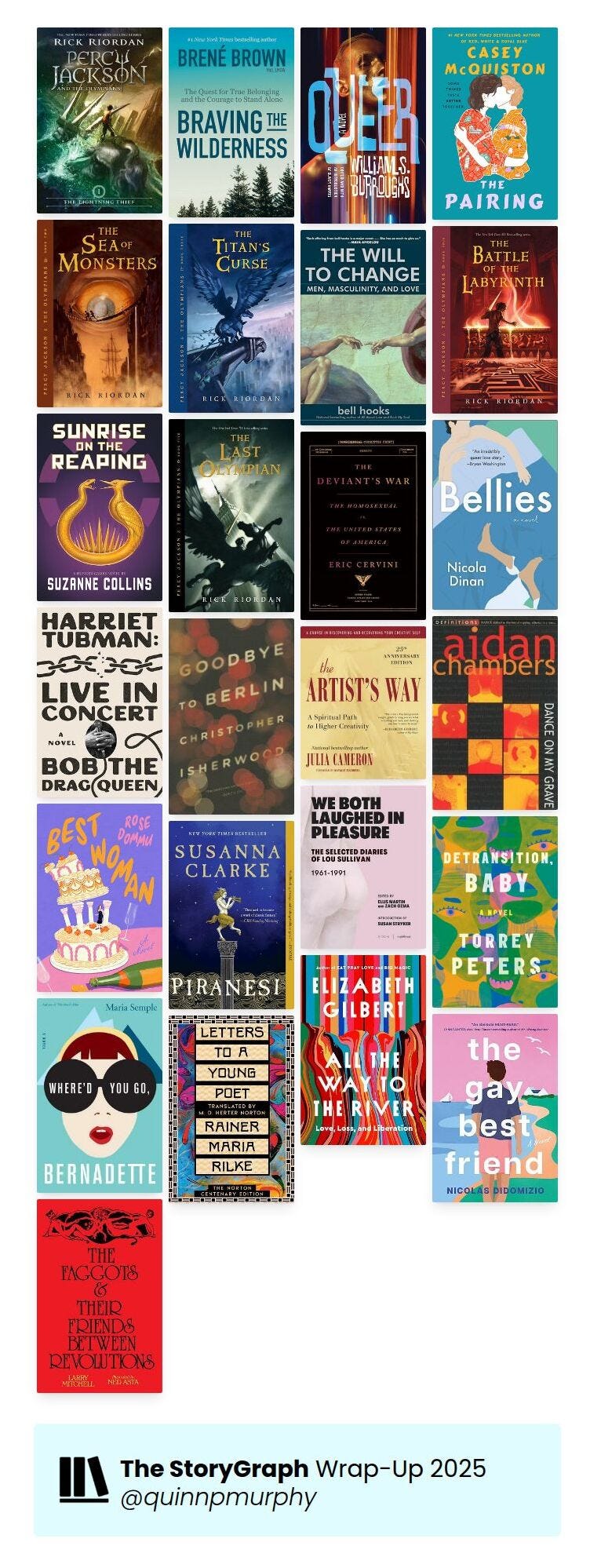
I will conclude by offering my 2025 Reading List. I do this not to suggest that you should read exactly what I do, but because, as I look forward to the rest of 2026, one of my goals is to be more intentional about recording my thoughts regarding what I have read. Finally, on the note of value, I do this also because I know that my recommendations, as a living, breathing human being, are much better for you than whatever drivel a large language model will bestow. Happy reading!
Nos. One, Five, Six, Eight, and Ten: Percy Jackson and the Olympians by Rick Riordan
I started the year by spending some time revisiting one of my favorite series from my childhood, Percy Jackson and the Olympians, which follows a demigod as he leads the war against a resurgent army of Titans. This was mostly inspired by the release of the new television adaptation of the series, which just finished airing its second season. For all the shit this adaptation gets online, it does mean something to me that Rick Riordan continues to make clear and consistent efforts to diversify the world he created unlike some other prominent authors of iconic children’s literature. Similarly to my return to Panem, catching up with the exploits of Percy and the gang was very nostalgic.
No. Two: Braving the Wilderness by Brené Brown
There was a time in my life wherein this was the most impactful book I had ever read. It did not hit the same for me on a reread; however, based on the little I know about her, I do think that Brené Brown is one of the less cynical actors in the “self-help” space, so I would recommend reading her if you feel inclined towards the genre.
No. Three: Queer by William S. Burroughs
After starting this year with reading the text and finishing the year with Luca Guadagnino’s 2024 adaptation, I just do not care for this story. It follows an older gay man chasing some young tail through Mexico City before that was the modus operandi for a certain type of gay guy. The published text is an unfinished manuscript of Burroughs’ and that shows! There is some intriguing stuff about desire in here though: “‘No one is ever really alone. You are part of everything.’ The difficulty is to convince someone else he is really part of you.”
No. Four: The Pairing by Casey McQuiston
I am constantly inspired by how Casey McQuiston just goes for it. Whether it’s the First Son of the United States locked in a torrid affair with the Prince of Wales, a woman in a relationship with a timehole-trapped lesbian on the Q train, or this novel, which finds two exes competing in a “sex-off” during a culinary tour of Europe, McQuiston is not afraid of plot and they are impressive in their ability to land the plane.
No. Six: The Will to Change by bell hooks
Fun fact: I was driving when I saw a notification that bell hooks had died. It was just before my final semester of college, and thus the first week of my capstone seminar for my Gender, Sexuality, and Women’s Studies major was a celebration of her work. For as vilified as my field of study continues to be, we’re often right and early to trends heteropatriarchal society takes much longer to catch up to. This work, published in 2003, was speaking about what has come to be known as “the crisis in men” or “the male loneliness epidemic” before it was even a twinkle in the eye of centrist grifters. While the first half of this absolutely sings, even hooks, much like the aforementioned grifters, tangles herself in her own feet trying to articulate a compelling and ideologically coherent difference between masculinity and femininity. In spite of this, hooks did make me think critically about my own relationship, as someone who was socialized as a man, to patriarchal domination and take some baby steps with my own tangled feet to let that go.
No. Nine: Sunrise on the Reaping by Suzanne Collins
The inspiration for this very essay! In retrospect, I wish I had waited a bit to take in The Hunger Games’ latest offering, which chronicles the fiftieth edition of the Games. Caught in the fever of the cultural moment, I couldn’t quite decide what I felt about the book. As I read the beginning, I remember Collins’ writing feeling thematically heavy-handed in a way that it usually is not. By the end, I was more sold on it and already excited for when I, inevitably, pick it up again.
No. Eleven: The Deviant’s War by Eric Cervini
One of the most impactful reads of the year, The Deviant’s War is a biography of gay rights icon Frank Kameny. Kameny, who dreamed of being an astronomer, was unable to work for NASA because he had been arrested for cruising in a public bathroom at a time when the U.S. government was purging its workforce of homosexuals. This inspired Kameny to begin the first organized movement for gay civil rights in the United States, much of which challenged Kameny and his allies to disentagle homosexual acts from the immorality they had been assigned in various legal codes. Reading this book in a period of renewed state-sanctioned anti-queer discrimination really motivated me to keep being a difficult queer in the face of the losers who would prefer to legislate me and my ilk out of existence.
No. Twelve: Bellies by Nicola Dinan
This was the last book I finished before my spell of illness last year, and, judging by how impacted I was when I reviewed the quotes I saved from it, that experience may have overshadowed its impact. Bellies is a novel primarily about two people falling in love, breaking up, and navigating their young adulthood in the wake of the breakup. I remember enjoying how it captures the messiness of the period in which I find myself, and it’s another one of those ones I know I’ll need to pick up again. I mean, a major plot point is one of the characters writing a play to process her breakup, how could I not relate? “Sometimes a person, an achievement, or a place–whatever is missing–seems the perfect shape to fill a void, so much so that its absence seems to be the cause of the problem and its presence the solution. But up close, the voids are always much larger.”
No. Thirteen: Harriet Tubman: Live in Concert by Bob the Drag Queen
Bob the Drag Queen is someone whose career I have followed for a decade now, so I was very curious when he announced that his first book would be a work of fiction as opposed to a memoir. Harriet Tubman: Live in Concert tells the story of Harriet Tubman being resurrected following The Return, which is a reanimation of a bunch of historical figures, and wanting to record a hip hop album. She enlists the help of a music producer who has reservations about being out to Harriet about his queerness. I had no doubts Bob actually wrote this book because of how much it sounds like him. However, the book possessed a lack of stakes throughout the majority of it that led to a frequent loss of interest on my part. Still, there’s a lot of good stuff in here about the nature of freedom and activism. I wish Bob had had a better editor who could have gotten him to flesh out some of the ideas, especially considering how short the novel is.
No. Fourteen: Goodbye to Berlin by Christopher Isherwood
Isherwood’s collection is one that I have wanted to read since visiting Berlin in 2022. It paints a foreigner’s portrait of the city on the precipice of Hitler’s rise to power. While I was enamored with the cast of characters, Sally Bowles in particular, I struggled with the lack of linear plot. I also found Isherwood to be a bit of a stale narrator as he was so clearly avoiding any discussion of his own sexuality.
No. Fifteen: The Artist’s Way by Julia Cameron
Yes, I finished The Artist’s Way twice before turning twenty-five. No, I don’t know what that says about me. I found Cameron’s iconic twelve-week workbook (that I did in closer to twenty due to my illness) similarly helpful the second time around. It was especially illuminating as I find myself in a more specific and focused part of my creative journey as opposed to one of creative aimlessness, which is more so where I was when I first completed the course in the summer of 2022. “There is one elementary truth, the ignorance of which kills countless ideas and splendid plans: that the moment one definitely commits oneself, then Providence moves too.”
No. Sixteen: Dance on My Grave by Aidan Chambers
I watched François Ozon’s 2020 film adaptation of this book, Summer of 85, in February and felt like I could lift a car afterwards. A few months later, I serendipitously found a copy of the source material at Giovanni’s Room in Philadelphia the same day Coco Gauff won the French Open (omg, such a gorgeous day to be Quinn Murphy I cannot even tell y’all). Chambers’ tale of teenage psychosexual obsession delivered in a beautiful way as I try to craft something similar in my own writing. I particularly liked the parts wherein the main character’s social worker describes him. I love anytime a book is able to use non-traditional techniques to move a story forward.
No. Seventeen: Best Woman by Rose Dommu
In a similar way to Bob the Drag Queen, I have followed Rose Dommu for many years now and was very excited to read her debut. In the vein of My Best Friend’s Wedding, Best Woman follows Julia, as she plays up her family’s lack of acceptance of her trans identity in order to seduce her high school crush. I loved Dommu’s characters in this novel but I was consuming a lot of media about people lying at the time (Twinless, Eleanor the Great), which made me care less for this than I normally would. Still a really solid debut and I am excited for whatever’s next for Dommu.
No. Eighteen: Piranesi by Susanna Clarke
I joined a book club this year and thank goodness I did because I do not think I would have read this book otherwise. Piranesi is a fantasy book that follows its eponymous main character as he lives his life in the House, which is a labyrinth of halls, rooms, and vestibules containing a seemingly infinite amount of statues. As the story unravels, Piranesi discovers secrets of the House that fundamentally reshape his knowledge of the world around him. In retrospect, probably my favorite new read of last year. Run, don’t walk!
No. Nineteen: We Both Laughed in Pleasure by Lou Sullivan
Another book club pick, We Both Laughed in Pleasure is a collection of selected entries from the diaries of queer icon Lou Sullivan. As a diarist myself, whenever I think about the notebook footprint I will inevitably leave behind, I am disconcerted by what people will think about me when they can read the thoughts I reserve for my journal. Reading Lou’s, however, gave me faith that people may be able to look past some of the more unsavory aspects and instead focus on the insight. In particular, I was struck by the lack of acceptance Lou faced in being a trans man who identified as gay, something that is relatively commonplace in my circles nowadays. If Lou were able to engage in The Return Harriet Tubman: Live in Concert-style, I know he would be having a good time in 2026.
No. Twenty: Detransition, Baby by Torrey Peters
As I got back into drafting my novel, I decided to reread what I can confidently say is my favorite book. I cannot believe Torrey Peters was able to sell and publish a novel that connects pregnancy to bug chasing within the first couple pages but when the writing is this undeniable, I suppose anything is possible. Detransition, Baby tells the story of Reese, Ames, and Katrina as they try to forge a new kind of family and navigate all the queer messiness that comes along with that. All three of them are bad people, but I love each of them so much.
No. Twenty-One: Where’d You Go, Bernadette by Maria Semple
Another reread, Where’d You Go, Bernadette follows the story of Bernadette Fox, a retired architect as she plans a trip to Antarctica, battles her agoraphobia, and swats away the other mothers at her daughter’s private school. Remember when I wrote about loving non-traditional techniques in literature? This book is the queen of that! A lot of the book consists of emails describing certain plot elements, interviews, and even articles about the titular character. Through it all, Semple skewers a certain type of liberal parenthood that existed at the end of history in such a genius way. This reread similarly cemented this novel as among my favorite books.
No. Twenty-Two: Letters to a Young Poet by Rainer Maria Rilke
A series of correspondences between Rilke and Franz Kappus still serves as a gospel of creativity nearly a century after its initial publication. Through the ten letters, Rilke meditates on convention, loneliness, and even sex. Similarly to how I felt reading The Deviant’s War, one of the real powers of literature is its ability to bridge that gap between then and now, to showcase to readers like me that people have been going through what they are currently experiencing for centuries before them, and Rilke’s letters are no exception. “Of course you must know that every letter of yours will always give me pleasure, and only bear with the answer which will perhaps often leave you empty-handed; for at bottom, and just in the deepest and most important things, we are unutterably alone.”
No. Twenty-Three: All the Way to the River by Elizabeth Gilbert
One of the year’s literary sensations, All the Way to the River is, the self-proclaimed “Eat, Pray, Love lady,” Elizabeth Gilbert’s memoir of her relationship with the late Rayya Elias. A more–perhaps the singular most–egregious example of a book needing a better editor, Gilbert tells a story that is briefly interesting but ultimately weighed down by her own attempts at relatability and lack of accountability. The only dimension of the book that I like is that she clearly needed to write this story for her own wellbeing. Whether it merited being published and earning her the millions she made off of it is something each reader will have to decide for themselves.
No. Twenty-Four: The Gay Best Friend by Nicolas DiDomizio
The Gay Best Friend follows Domenic as he struggles to serve as both his childhood best friend’s best man and a member of his best friend’s fiance’s bridal party. It was a book that got passed around among my friends on our 2024 trip to Puerto Vallarta, and I can see why. Amazing beach read, also amazing for someone trying to blow through something quick, dishy, and a little sexy before the end of the year.
No. Twenty-Five: The Faggots and their Friends Between Revolutions by Larry Mitchell, illustrated by Ned Aster
The Faggots and their Friends Between Revolutions is a book unlike any other one can read. It tells the story of the faggots, the fairies, the women, and other friends as they live in the underground of Ramrod awaiting the next revolution. Part meditation, part manifesto, it’s a really special text. Revisiting this book made me realize how much closer to my life it feels now than the last time I read it. As I read about Pinetree, and Heavenly Blue, and Loose Tomato, I couldn’t help but think about the beautiful people who surround me and assure me that I’m on the right track.
Quinn’s Hot Tips:
The Secret History by Donna Tartt
“Girls Gone Wild” by JT
I make envy on your disco by Eric Schnall
“Dancing on The Wall” by MUNA
Wuthering Heights by Charli XCX
Love Story: John F. Kennedy Jr. & Carolyn Bessette
The Pitt, season two, episode seven: “1:00 P.M.”
“YDH” by Chloe Qisha
Although, there is some blame to be placed on Coco Gauff, whose Australian Open quarterfinal I’d stayed up until 3 AM to watch; however, she was playing so exceptionally bad that I had to turn it off when she went down 0-3 after losing the first set 1-6.
You’ve officially inspired me to reread Twilight. Thank you. Truly, thank you.
“While I did admire the store’s collection, it also made me melancholic. My awe at this litany of literary offerings had given way to a fatalistic realization that I would never be able to read them all.”
That feeling is so bittersweet — wonder curdling into the ache of limits. But maybe the impossibility is part of the magic, too. The shelves don’t demand you read them all — just that you choose a few to love.